


Anxious about starting nursery this September?

September is always a month of change in early years.
This week, our term-time children returned to Fun Box after their six-week summer break. Some of our little ones who previously attended the Baby Room moved into Preschool for their full days. We have welcomed some brand-new babies and children through our doors, with more joining us over the coming weeks. And beyond our nursery gates, our former pre-schoolers have put on their school uniforms and started their next adventure at “big school”. These transitions may look very different, but they often have two things in common: separation and uncertainty.
For children — and sometimes for their parents too — both can bring some very big feelings.
When saying goodbye is hard
A child starting nursery for the first time may cling tightly to Mum or Dad, become upset as they prepare to leave or cry at the point of saying goodbye.
For parents, seeing their child distressed can be extremely difficult.
Separation anxiety is particularly common in babies and young children. As children become increasingly aware of the people they feel safest with, they also become more aware when those people are no longer beside them. Young children are still developing the experience and understanding that help them feel confident that a separation is temporary and that their parent will return.
Alongside separation anxiety can come another perfectly understandable feeling: uncertainty about the unknown.
A new nursery, room or school brings unfamiliar adults, surroundings, routines and experiences. Children need time to discover who will care for them, what happens during their day, where things are and what will happen next. All of this can present itself in different ways. Some children may cry or cling to their parent. Others may become unusually quiet or cautious, while another child may walk straight through the door and begin exploring.
Every child is different.
Tears do not mean something has gone wrong
Seeing a child upset at drop-off can naturally be worrying, but separation anxiety is a normal part of development for many young children. It can also be associated with the strong attachment a child has developed to the important adults in their life.
That certainly does not mean that children need to cry to demonstrate a strong attachment. Some children settle very quickly and happily wave goodbye from the beginning. What is important is the experience children gradually build through these early transitions.
Each successful separation followed by reunion helps children learn that their parent comes back, that they can feel safe with other trusted adults and that unfamiliar situations can, in time, become familiar.
With sensitive support, these experiences become important steps towards independence. Children gradually build confidence in new relationships, learn ways of managing difficult emotions and discover that they are capable of coping with change.
This is one of the ways emotional resilience develops — not through children simply being expected to “get on with it”, but through manageable experiences of change supported by adults they trust.
Making the unfamiliar familiar
This is why settling-in sessions are much more than simply an opportunity for a child to come in and have a little play before they start. They give children time to explore their new surroundings without immediately having to manage a full nursery day. They can begin recognising faces, discovering toys and resources and becoming familiar with their new environment.
And settling-in sessions are equally important for us as practitioners.
To support a child properly, we need to understand the little details that make each child who they are.
This may involve questions such as: Do they drink formula or breast milk? When do they normally nap, and for how long? How do they usually fall asleep? Do they use a dummy or comforter? What helps when they are upset? What makes them laugh? Which toys, songs, characters and activities capture their interest?
We do not ask these things simply because they are interesting to know. They help us provide continuity between home and nursery and respond to each child as an individual.
Familiar objects can also be enormously helpful. A favourite teddy, dummy or comforter — or sometimes an item carrying the familiar scent of a parent — can bring an element of home into a new environment.

Then, of course, there is engagement.
An interesting new toy, bubbles, water play, a favourite song, sensory exploration or an exciting activity can gently draw a child's attention towards all the enjoyable things happening around them. As relationships develop and the environment becomes familiar, children usually need less and less support to separate.
Routines create security
Young children benefit greatly from predictability.
Knowing the rhythm of the day — when they play, eat, sleep, go outside and eventually go home — provides reference points and helps a new environment begin to feel familiar.
This is particularly important for children moving from our Baby Room into Preschool.
They already know Fun Box. They recognise many of the adults and children, and the building itself is familiar. However, Preschool still introduces a different environment, different routines, a larger social group and many new experiences. Moving rooms is therefore a genuine transition in its own right, and children need the same sensitivity and support while they find their feet.
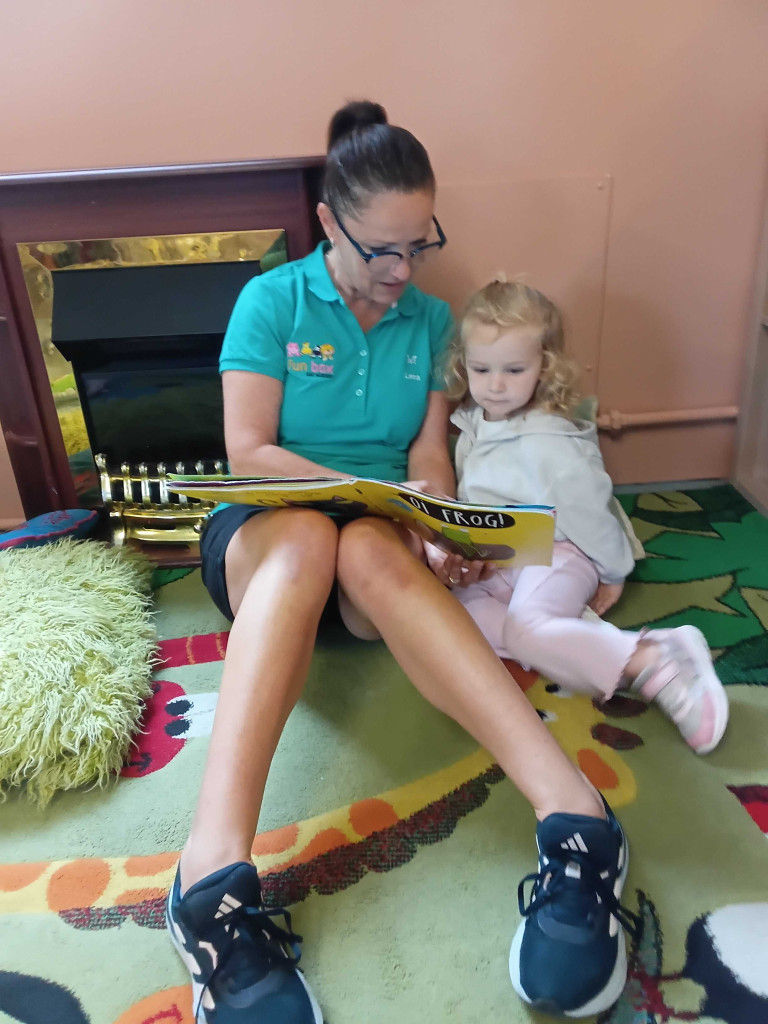
It is also one of the reasons All About Me is such an important part of our first half term.
Our Fun Box curriculum is built around a simple principle: relationships and emotional security come before learning.
Before children can fully engage with everything an early-years environment has to offer, they need to begin feeling safe, known and valued within it. Learning about their families, interests, likes and dislikes, experiences and individual personalities helps us build those relationships and gives children a sense of belonging.
Once those foundations are in place, exploration and learning can flourish.
Coming back after the summer
For our term-time children returning after six weeks away, September can feel slightly different.
The environment is already familiar. They know their key person and other practitioners, recognise the children around them and remember the toys, resources and activities they enjoy. Their re-settling period therefore tends to be shorter and smoother, although that does not mean there cannot still be some hesitation at the beginning.

Six weeks is a long time in the life of a two- or three-year-old. Routines may have changed over the holidays, and returning to nursery mornings, longer days and separating from parents again may take a little readjustment. The big advantage for returning children is familiarity.
Seeing their friends and practitioners again, rediscovering favourite toys and returning to activities they know and enjoy can quickly rebuild that sense of belonging. Some children may temporarily benefit from a familiar comfort object again too.
Usually, the rhythms and relationships of nursery life soon begin to feel familiar once more. As we saw when we welcomed everyone back last September, those first days are often filled with a mixture of re-settling, reconnecting with friends and becoming absorbed again in familiar play and activities.
And then comes big school...
For our school leavers, another major transition has just begun, and in many ways the principles are similar to starting nursery. There is a new building to navigate, new adults and children to get to know and new routines to learn.
The difference is that four-year-olds usually bring with them several years of previous experiences. They have already experienced saying goodbye and being reunited with their parents. They have learnt to build relationships with trusted adults outside their family, make friends, ask for help, manage frustrations and adapt to changes in routine. All of these experiences contribute to their growing emotional resilience. And being older certainly does not mean there cannot still be nervous mornings, difficult goodbyes or even a few tears.
Schools understand the importance of transition too. Those first weeks are about much more than starting phonics or maths. Children need time to understand their environment, establish relationships, become familiar with routines and develop a sense that they belong there.
Again, the principle behind our own curriculum applies: relationships and emotional security come before learning.
Our school leavers may have moved beyond Fun Box, but many of the skills that help them settle into their new classrooms began developing through all those smaller transitions that came before.
Starting nursery: Parents go through transitions too
There is another important side to the transition process: the experience of parents.
Leaving a baby or young child in somebody else's care for the first time is a significant milestone, and it is perfectly understandable for parents to experience uncertainty too. There may be questions about whether their child will settle, eat or sleep; whether practitioners will recognise when they are tired or upset; whether they will be comforted when they need it; or simply what their day will look like once their parent has walked through the door.
Getting to know the adults who will care for their child, understanding the nursery environment and becoming familiar with routines can therefore be just as valuable for parents as it is for children.
We are very aware of the responsibility families place in us when they leave their child in our care. And once again, our curriculum principle comes into practice: relationships and emotional security come before learning — and those relationships include families too.
A trusting relationship between parents, practitioners and a child's key person is not built from one conversation on the first morning. It develops through communication, consistency and getting to know one another.
Settling-in sessions give us time to discuss children's routines, preferences, interests and current development before they start.
During those first weeks, detailed handovers can be particularly valuable. We talk about how the day has gone, what children have eaten, whether they have slept and for how long, what they have enjoyed, what has helped them settle and those little moments from the day that parents otherwise would not have seen.
Through Tapestry — and the Care Diary for our under-twos — families can also follow elements of their child's day, activities and routines.
And if a parent would simply like some reassurance during the day, they are welcome to telephone us and ask how their little one is getting on.
Sometimes an individual child or family needs a slightly different approach. Transitions are not one-size-fits-all, so wherever possible we tailor the process to the child and family in front of us, using our professional knowledge alongside the information parents know best about their own child.
Growing through change
Transitions are part of childhood.
Starting nursery, moving into Preschool, returning after a long break and beginning school all ask children to leave something familiar and gradually build confidence in something new. That process will look different for every child. Some settle almost immediately. Others need considerably more time, reassurance and support. Neither response makes one child more confident, secure or “ready” than another. What matters is that children are given the time, relationships and emotional support they need to make that transition successfully. And gradually, the unfamiliar becomes familiar.
The new practitioner becomes someone they know and trust. New children become friends. Routines become predictable. Children begin exploring more confidently, joining activities and making the environment their own.
For parents, that same period often brings its own adjustment. Over the first few weeks they too have the opportunity to become familiar with the people caring for their child and to build confidence in the relationship between home and nursery. These are small but important steps in a child's journey towards independence. There may be some difficult goodbyes along the way — and there will also be many increasingly confident hellos.
And that is what a successful transition is really about: not expecting children to be unafraid of change, but helping them discover that they can manage it with the right people beside them.


Very interesting read. extremely important. Thanks.