


Can I Get Funded Childcare—and When Does It Start?🔢🪙👶

If you have ever tried to work out childcare funding and ended up with several webpages open, a calendar in one hand and still no clear answer, you are certainly not alone. Most parents simply want to know three things:
Can I get funded childcare?
How many hours will I receive?
And when can my child start using them?
The system is not impossible to understand, but it is rarely explained in the order parents naturally ask the questions. There are different types of funding, different eligibility rules and a few very important dates—and missing one of those dates can mean waiting until the following term.
The Government’s Best Start in Life website is a useful starting point. Alongside childcare support, it includes information about child development, potty training, screen time, feeding and many of the other questions that tend to appear somewhere between breakfast and bedtime. (Best Start in Life)
Here we gathered all the key-information you need to know about Funded Childcare (England).
(You can also find some additional info in our previous articles:
First Things First: Which Funding Are We Talking About?
There are three main early years funding entitlements that parents are likely to come across. They sound similar, but they are intended for different children and families. The easiest way to understand them is to look at each one separately.
Working Families Entitlement
This is the 30-hour entitlement for eligible working families. It is available from the funding period after a child turns nine months old until they start school.
It provides up to 1,140 funded hours each year. Families can normally use 30 hours per week over 38 weeks, or fewer weekly hours when a provider stretches the entitlement across more of the year. (Best Start in Life)

Official information: Best Start in Life: 30 Hours Childcare
Early Learning for 2-Year-Olds
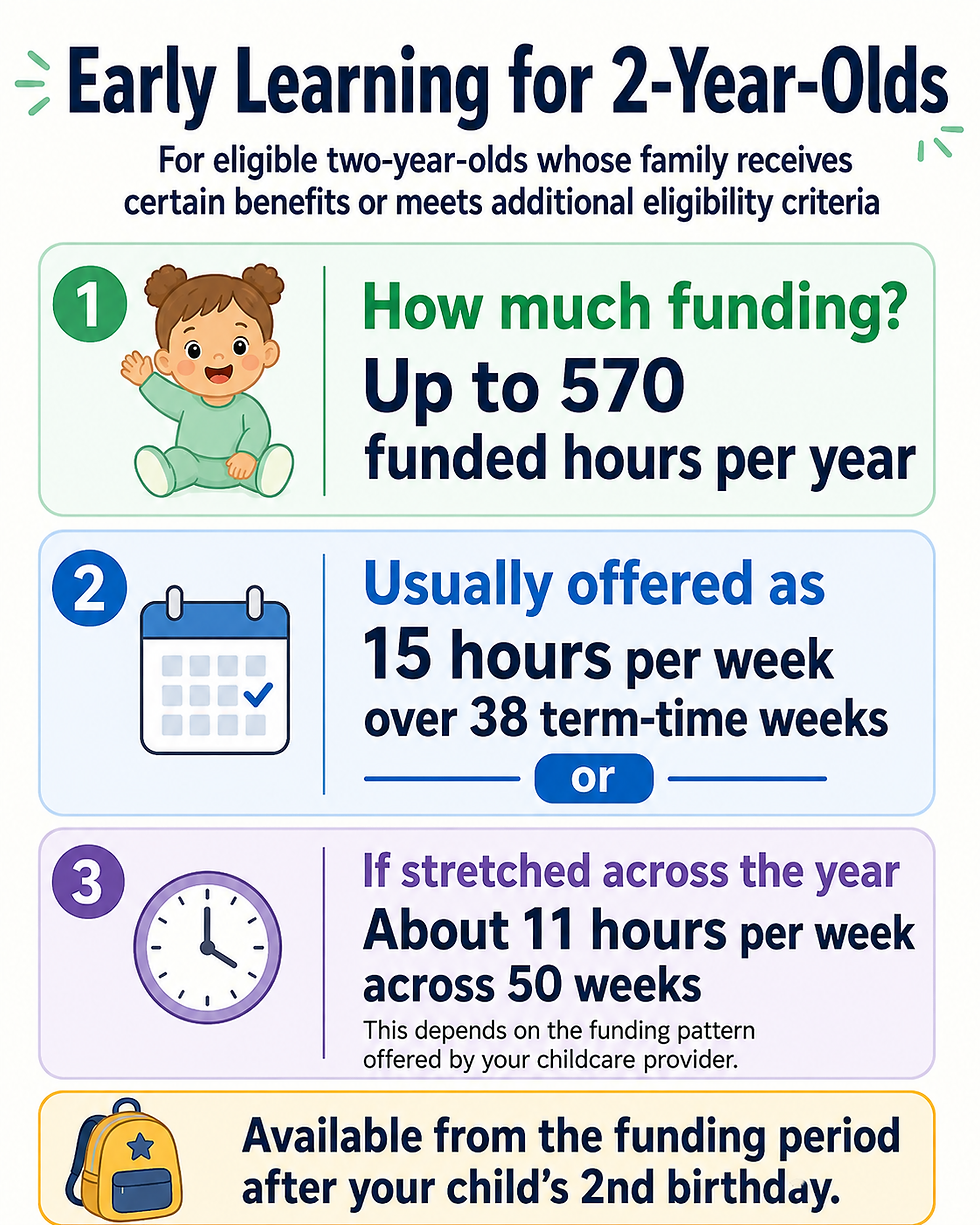
This entitlement provides 15 funded hours for eligible two-year-olds whose family receives certain support or whose child meets particular criteria. It provides up to 570 funded hours per year. It is separate from the Working Families Entitlement, although some two-year-olds may qualify for both. (Best Start in Life)
Official information: Best Start in Life: Early Learning for 2-Year-Olds
Universal Funding for 3- and 4-Year-Olds
This is the simplest entitlement: every three- and four-year-old living in England can receive 15 funded hours, regardless of their parents’ employment, income or family circumstances.
The entitlement provides 570 hours per year and begins from the funding period after the child’s third birthday. (Best Start in Life)

Official information: Best Start in Life: Universal 15 Hours
Do the Different Hours Add Together?
This is a very reasonable question—and one that causes plenty of confusion. For eligible three- and four-year-olds, the 30-hour Working Families Entitlement already includes the universal 15 hours. It does not normally mean 15 hours plus another 30 hours, giving a total of 45.
An eligible two-year-old may receive 15 hours through Early Learning for 2-Year-Olds and another 15 hours through the Working Families Entitlement, giving them 30 hours altogether. (GOV.UK)
So, Who Actually Qualifies?
This is where the three entitlements begin to look very different. One depends mainly on the parents’ work and earnings. Another is linked to benefits or the child’s circumstances. The universal entitlement requires neither.
Eligibility for the Working Families Entitlement

Official source: Best Start in Life: Working Families Eligibility
Parents apply online and receive an 11-digit eligibility code to share with their childcare provider. The details in the childcare account must then be reconfirmed every three months—even if the child has not started using their funded place yet. (GOV.UK)
Eligibility for Early Learning for 2-Year-Olds

Official source: Best Start in Life: Early Learning Eligibility
In Hampshire, parents apply through the Hampshire Education Online Portal. If eligibility is confirmed, they receive a reference beginning with TYF, which must be shared with their chosen childcare provider.
Eligibility for Universal Funding

Official source: Best Start in Life: Universal Offer Eligibility
When Does the Funding Actually Start?
Here comes the part that catches many families out. Funding does not usually begin on the exact day a child turns nine months, two or three years old. Instead, it begins at the start of the following funding period.
In Hampshire, the three funding periods begin on: 1 January, 1 April and 1 September.
This means that two children who are only a few days apart in age can sometimes begin their funding several months apart. Slightly annoying? Yes. Important to know? Absolutely. (Hampshire County Council)
For Working Families Claiming from Nine Months
The child must have turned nine months old before the relevant funding period begins.

For example, if your baby turns nine months old on 31 March, funding may begin from 1 April. If your baby turns nine months old on 2 April, they have missed the April starting point and will normally have to wait until the funding period beginning on 1 September. It is not particularly intuitive, but once you stop thinking in terms of the child’s exact birthday and start thinking in terms of the next funding period, it becomes much easier.
For Children Turning Two or Three
The same termly pattern applies when a child becomes eligible for Early Learning for 2-Year-Olds or Universal Funding for 3- and 4-Year-Olds.

When Do Working Parents Need to Apply?
For the Working Families Entitlement, HMRC must confirm your eligibility by:
31 March for funding beginning on or after 1 April
31 August for funding beginning on or after 1 September
31 December for funding beginning on or after 1 January
These dates are the final deadlines—not the dates we would recommend beginning the application. Some applications need additional checks and can take between 10 and 15 days. Hampshire therefore recommends applying earlier:
Between 15 January and 28 February for an April start
Between 15 June and 31 July for a September start
Between 15 October and 30 November for a January start. (Hampshire County Council)
In other words, please do not wait until 11.47 pm on 31 August while trying to remember a password you last used three months ago.
Once your code has been issued, share it with your childcare provider together with your National Insurance number and your child’s date of birth. Your provider will check the code and confirm when the funded place can begin. You must also reconfirm your eligibility every three months. HMRC should send a reminder, but it is sensible to make a note of the date yourself rather than relying entirely on an email finding its way through the mysterious wilderness of the spam folder. (Hampshire County Council)
Official source: Hampshire County Council: Funded Childcare for Working Families
Does “Funded” Mean That Everything Is Free?
Not necessarily.
The funding pays for a set number of early education and childcare hours. Depending on the provider, parents may still be charged for additional hours, meals, snacks, nappies, consumables, outings or optional activities. Your provider should explain these charges clearly before your child begins.
Where extras are optional, families who do not wish to purchase them should be offered a reasonable alternative—for example, bringing a packed lunch or providing their own nappies. (GOV.UK) It is always worth asking your chosen nursery, preschool or childminder:
How are the funded hours offered?
Can the hours be stretched across the year?
Which additional charges will still apply?
Two providers may be working with exactly the same government entitlement while offering it through quite different session patterns.
Other Ways to Help With Childcare Fees
Funded hours may cover a substantial part of a family’s childcare, but they do not always cover every hour parents need. Two other forms of support may help with the remaining cost.
Universal Credit Childcare
Working parents receiving Universal Credit may be able to claim back up to 85% of their eligible registered childcare costs. From April 2026, the maximum amount available during each monthly assessment period is £1,071.09 for one child and £1,836.16 for two or more children.
Parents usually pay the childcare bill and report the cost through their Universal Credit account, although support with upfront childcare costs may sometimes be available when starting work or increasing working hours. (Best Start in Life) Universal Credit Childcare can be used alongside funded early years hours to pay towards additional childcare. However, it cannot be received at the same time as Tax-Free Childcare.
Official source: Best Start in Life: Universal Credit Childcare Eligibility
Tax-Free Childcare
Despite the slightly misleading name, Tax-Free Childcare is not a tax deduction. Parents pay money into an online childcare account, and for every £8 they add, the Government adds another £2.
The government contribution is worth up to £500 every three months—or £2,000 per child each year. For an eligible disabled child, this increases to £1,000 every three months or £4,000 per year. (Best Start in Life)
Tax-Free Childcare can be used alongside funded childcare to pay for additional sessions, before- and after-school care or holiday clubs, provided the childcare provider is registered with the scheme.
It cannot be claimed at the same time as Universal Credit Childcare or childcare vouchers.
Official source: Best Start in Life: Tax-Free Childcare Eligibility
The Three Questions Every Parent Should Ask
When trying to understand your childcare support, begin with three simple questions:
Which funding entitlement applies to my child?
Which funding period follows the date they become eligible?
Do I need to apply, receive a code or reconfirm my details before a deadline?
Once those three questions are answered, the system becomes far less mysterious.
Parents can also use the Best Start in Life Childcare Checker to answer a few questions about their family and see which government schemes they may be eligible for. (Best Start In Life)
At Fun Box Day Nursery, we are always happy to explain how funded hours work within our setting and which information we need from you. We cannot decide whether a family qualifies for the Working Families Entitlement—that decision is made by HMRC—but we can help you understand the dates, check your eligibility code and complete the nursery paperwork.
Because sometimes all a parent really needs is not another government page, but somebody to sit down and say: “Right, let us work out which one applies to you.”


Đăng ký F8bet làm tôi quan tâm khi xem xét khả năng tìm lại biểu mẫu sau khi rời khỏi khu vực tài khoản. Tôi thử mở phần hỗ trợ, quay về trang chính rồi tìm lại khu vực đăng ký để kiểm tra vị trí chức năng. Các mục liên quan đến tài khoản được sắp xếp theo nhóm nên tôi có thể nhận diện nhanh nơi cần truy cập. Tôi cũng chú ý đến cách tiêu đề và nút thao tác được đặt cạnh nhau, giúp giảm việc phải đọc lại toàn bộ nội dung. Luồng điều hướng này tạo cảm giác dễ theo dõi khi thực hiện nhiều bước
Nạp tiền MM88 khiến mình chú ý đến sự cân bằng giữa số lượng danh mục và khả năng nhận diện từng khu trên giao diện. Game bài, casino và bắn cá được phân chia riêng, nên mình có thể xác định hướng lựa chọn mà không cần xem từng nội dung cụ thể ngay lập tức. Mỗi khu đóng vai trò như một phạm vi để mình tiếp tục tìm kiếm khi cần. Mình đánh giá cách bố trí này giúp giao diện có nhiều hướng khám phá nhưng không tạo cảm giác phải xử lý tất cả cùng lúc. Khi đã quen cấu trúc, mình có thể tìm lại từng khu khá chủ động.
Thank you for this!!
It’s such handy information to have all in one plece x
Thank you! So much clearer! Sometimes it can be such a faff, trying to pick through all the relevant bits of information to work out what applies to us and what's needed where.
This is great thank you. So good to have the different information all together and clearly explained.